Equipment vendors often picture a straightforward transaction where a buyer walks in, likes what they see, and pays. Even when it looks like a cash sale, it's rarely that simple because equipment buyer financing is usually part of the picture.
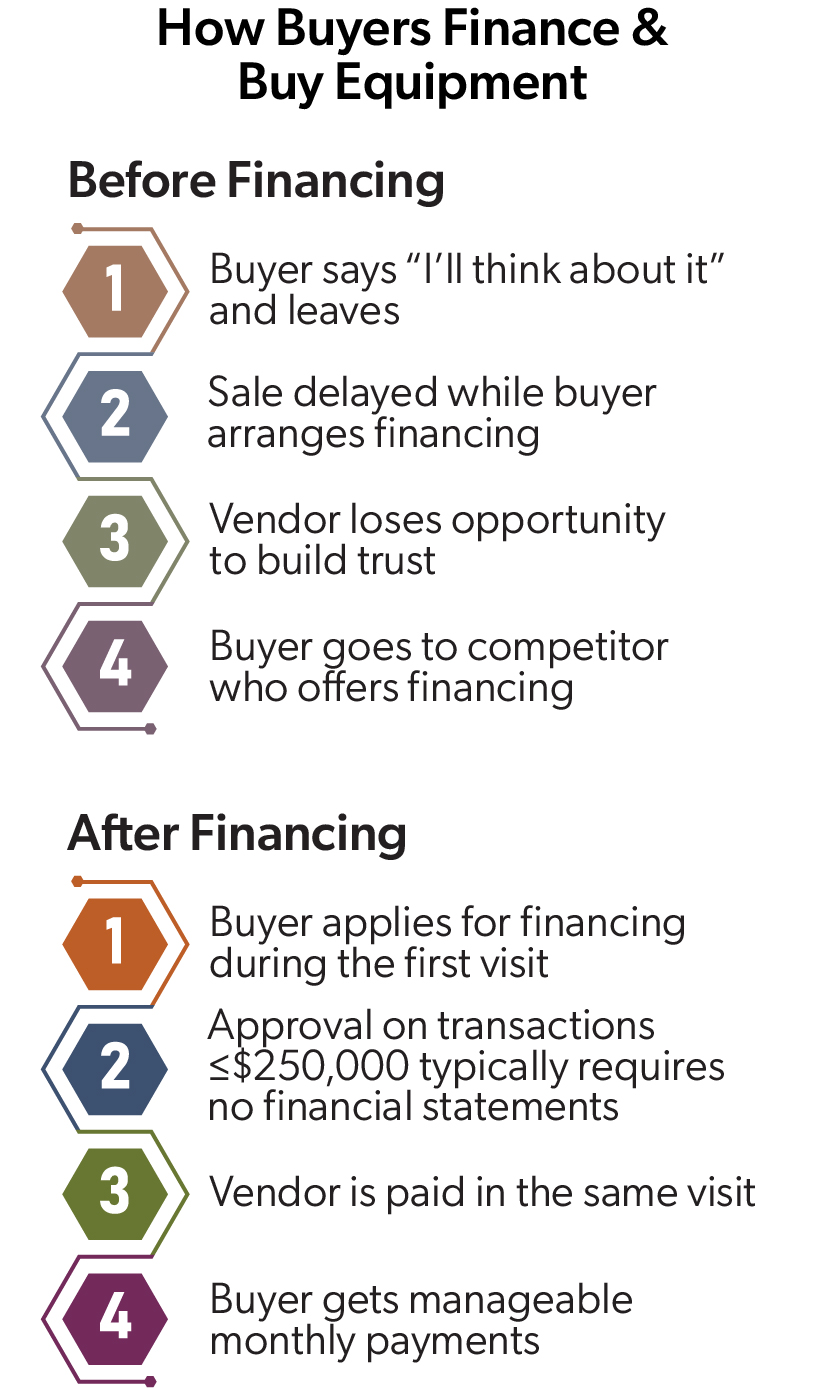
Consider the buyer who looks over a work truck, hears the price, and says they'll think about it. They leave, check what’s left on their line of credit, and search for equipment financing online. By the time they are ready to buy, they’ve lined up financing and they don’t always come back to the vendor who let them get away without offering financing during their first visit.
What Happens Before an Equipment Buyer Reaches You?
 Understanding equipment buyer financing behavior starts well before a buyer ever sets foot on the lot. Most buyers research cost online first, compare prices, and get a sense of the options available. Many also check in with their own banker or take stock of what's available on a business line of credit, quietly lining up options before a vendor even knows they're in the market.
So how do equipment buyers pay in practice? Cash on the spot is the exception, not the rule. A lot of buyers, especially contractors and small business owners with limited time, would rather fill out a one-page credit application with the vendor directly than make a separate trip to the bank. That works in an equipment vendor's favor, but only if financing is on the table at the first conversation. If it isn't, the buyer defaults to the research path they already know, and the vendor gives up more than the sale. Financing is often where the real relationship starts, tied to service, repeat purchases, and referrals down the line. When a buyer arranges it elsewhere, that entry point closes.
Why Do Equipment Buyers Walk Away From A Sale?
Every hour a buyer spends comparing options elsewhere is an hour a vendor isn't part of the conversation. Go back to the buyer eyeing that work truck: once they walk off the lot to "think about it," the vendor has no way to see what happens next. Here are a few routes they often take:
- The buyer keeps shopping instead of signing. Without financing on the table, "I'll think about it" often turns into another lot visit, another price comparison, and another delay. The longer that search stretches on, the more the original vendor becomes just one option among several.
- A competitor closes the sale with financing already attached. When a rival vendor's unit comes bundled with payment options, that convenience tends to influence where the buyer lands. A buyer who's already tired of comparison shopping will often take the first offer that makes their life easier, not the best offer overall.
- The deal goes cold fast. Once a buyer is off-lot, the vendor has no control over what they see, hear, or decide next. A day's delay can be the difference between a signed deal and a buyer who's moved on to a different make, model, or dealer altogether.
When a vendor loses a sale, it’s rarely on price alone. The winning vendor usually offers the best combination of options, price, and easy equipment financing.
Why Do Traditional Lenders Turn Some Equipment Buyers Away?
A buyer who walks into a bank looking for equipment financing doesn't always get a straightforward yes. Many traditional lenders evaluate a business as a whole, including cash flow, credit history, and existing debt. Equipment is harder for them to price. A bank loan officer isn't trained to know what a used work truck or a piece of manufacturing equipment is worth, what it will be worth in five years, or how quickly it could be resold if a loan went unpaid. That uncertainty causes many banks to act conservatively, and it's part of the reason why "just go to your bank" often doesn't work for this kind of purchase.
Equipment finance partners approach the same equipment transaction differently. Instead of underwriting the business alone, they underwrite the asset. They know equipment values, resale markets, and depreciation curves well enough to lend against the equipment. That difference often separates an approval from a decline, and it's a big part of why financing conversations that start with a vendor tend to move faster than the ones that start at a bank.
Most Equipment Purchases Already Involve Financing
The numbers back up what's happening on the lot. A recent industry study found that more than 8 in 10 U.S. companies use some form of financing when acquiring equipment, whether that's a loan, a lease, or a line of credit. Equipment financing is the default path for most buyers.
The scale reflects that. The U.S. equipment finance industry totals roughly $1.34 trillion, or about 58% of the $2.3 trillion businesses invest annually in equipment and software. Most of that activity falls into what the industry calls small-ticket equipment finance, generally defined as financing under $250,000, which covers the size of transaction most vendors handle every day.
For a vendor, that context changes the question. It's not whether a buyer will finance their purchase. It's whether they'll finance it with the vendor or find it somewhere else.
How Independent Vendors Compete With Captive Financing
Large dealer networks often have a captive finance arm built into the business, creating an advantage over independent equipment dealers. These in-house financing companies, sometimes tied to a well-known manufacturer, account for roughly 17% of the financed acquisition market. When a buyer can finance and buy in the same conversation, that convenience becomes part of the sale.
An independent vendor doesn't need to build that infrastructure to compete with it. Working with the right financing partner can offer:
- A point-of-sale financing tool, so a buyer can apply and get approved on the first visit, not after a separate call or trip to the bank.
- No overhead of running a finance company, since the vendor gets the benefit of in-house financing without the cost or complexity of building it.
- The backing of a stable, established partner, which matters to a buyer trusting that relationship with a major purchase. A financing partner that’s tied to a publicly traded bank brings a level of transparency a smaller or newer lender may not offer.
That combination gives an independent vendor the same close-the-loop advantage a captive offers, without needing the overhead or infrastructure.
The Vendor Financing Process for Your Customer
Point-of-sale financing for equipment dealers works best when it stays simple for the buyer. Here's what that process looks like with First Business Bank’s Equipment Finance team:
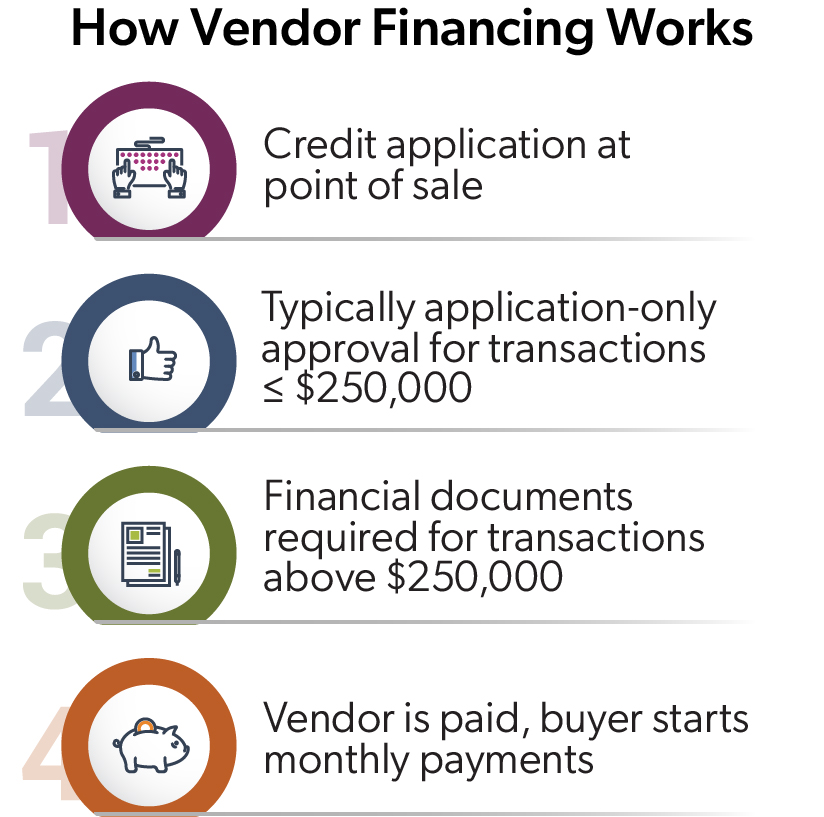 The buyer fills out a credit application at the point of sale. No hunt for financing, no sale delay.
- For transactions at or below $250,000, approval is typically application-only. No financial statements are usually required, which keeps the process fast. Typical application-only decisions are made in hours, not days, allowing for fast turnaround.
- Above $250,000, some financial documents are required to provide the details needed to underwrite a larger transaction. Find out which documents are often needed in our resource, “How To Get Fast Approval for Business Equipment Financing.”
- Once approved, the vendor gets paid and the buyer has manageable monthly payments instead of a depleted bank account or a stalled deal.
None of these steps require the buyer to leave the lot, which is the point. The equipment dealer credit application happens in one visit, not a separate trip to the bank or to another vendor who offers financing.
Every buyer walking onto a lot is already somewhere on this path, whether a vendor sees it or not. Some have already checked their line of credit. Some have already started searching online. Some are checking prices and financing options at the nationwide vendor across town.
Vendors who offer financing before a buyer goes looking for it keep control of the sale, and the relationship that comes with it. That's often the difference between hoping for the next sale and knowing how to sell more equipment on a consistent basis. First Business Bank's Equipment Finance team works with vendors to put point-of-sale financing in place, so the next buyer who says "I'll think about it" has a real reason to finish their sale where they started it.
Frequently Asked Questions About Equipment Buyer Financing Behavior
Do most equipment buyers pay cash?
No. A recent industry study found that more than 8 in 10 U.S. companies use some form of financing, whether that's a loan, a lease, or a line of credit, when acquiring equipment. A cash sale is the exception, not the rule.
How fast is approval for equipment financing?
It depends on the size of the transaction. For purchases at or below $250,000, approval typically requires only an application, with no financial statements required, which keeps the approval to hours only. Larger transactions require financial documents, which take more time to underwrite.
What's the difference between small-ticket and standard equipment finance?
Small-ticket equipment finance generally refers to financing under $250,000, the range where most vendor transactions fall. These deals typically move through a faster, application-only approval process. Larger, standard equipment finance transactions require more documentation and a longer underwriting timeline.
Why would an equipment buyer choose vendor financing over their own bank?
A general-purpose bank underwrites the buyer's overall business, including cash flow, credit history, and existing debt, and it may not be equipped to value equipment as collateral. A vendor's financing partner underwrites the equipment itself, which often makes for a faster decision and an easier approval than a traditional bank loan.
Update date: 10/29/2026