

With tight margins and fierce competition for every customer, independent used car dealers are always looking for ways to get more sales without adding employees. Our floorplan financing team works with dealers facing these challenges, and we're seeing more independent dealers move from testing AI to depending on it. As AI budgets climb across the industry, the dealers waiting on the sidelines are giving up ground they may not get back.
We sat down with Ross Tinkham, Vice President and General Manager of Automotive at Podium, who has spent nearly a decade working with car dealers. He and his team have helped thousands of independent car dealers implement AI-powered lead management solutions. Podium operates as a comprehensive communication platform that helps dealers engage and convert leads across text, phone calls, web chat, social, and email. It’s AI employee, Jerry, handles customer interactions from initial contact through scheduled test drives and service appointments, working around the clock without added headcount.
"Podium is an operational platform that dealers use primarily to engage with and convert leads," Tinkham said. The platform has evolved significantly, with AI agents now capable of carrying conversations "all the way through to completion," nurturing leads, answering questions, suggesting inventory, and scheduling test drives without involving a human.
As part of our commitment to providing value beyond financing, we wanted to get car dealers these insights from an industry expert. We asked Tinkham what independent used car dealers should know about AI before buying in, along with questions he frequently hears from car dealers about AI and how AI helps independent used car dealers solve real-world problems to compete.
1. How Does AI Capture After-Hours Leads For Car Dealerships?
As many dealers we work with already know, a huge portion of car business happens when dealerships are closed. Most customers are busy, they have families and jobs, so they shop online late at night after the kids are in bed. If they submit a request through a dealer’s website and don’t get a response, they move on quickly to the first dealer that returns their message.
AI agents work around the clock. They are always on, ready to engage a customer the second they show interest. "Some of the independent dealers that we partner with are seeing 40% of their leads submitted after hours," Tinkham said. "That customer is likely submitting a lead, not just to you, but potentially someone else... in a lot of cases, it just comes down to who gets to that customer first." AI ensures you're always the first to respond.
2. Why Does 5-Minute Lead Response Time Matter For Used Car Sales?
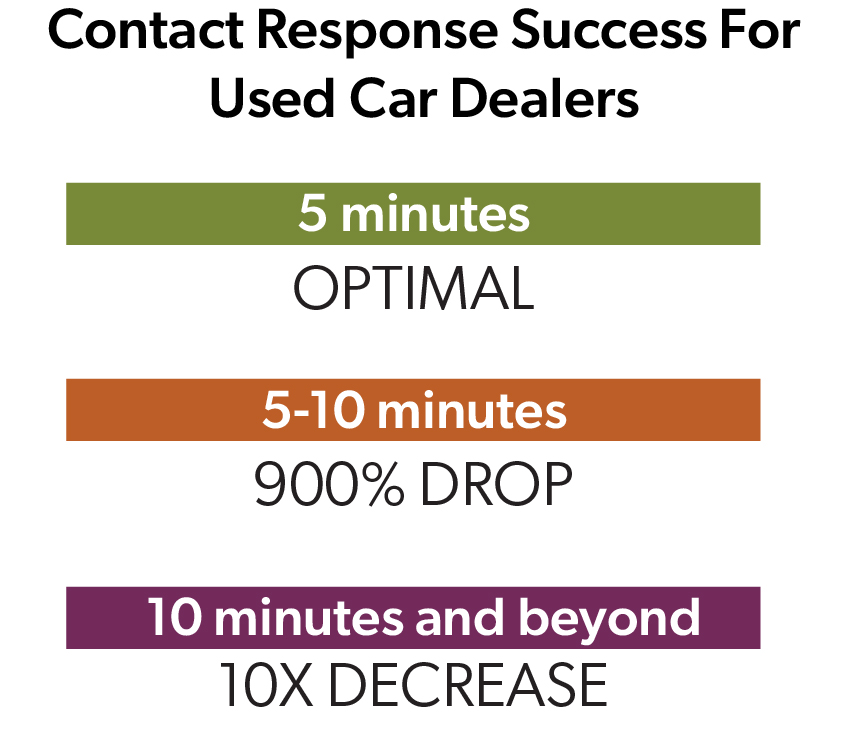 Tinkham pointed out that a Harvard Business Review study analyzing over 15,000 leads shows that most businesses fail at lead response. In talking with used car dealers, it sounds like there are massive opportunities for those who get this right. The study showed that lead conversion rates drop 10x if customers wait longer than five minutes for a reply. After five minutes, there’s a 900% drop in contact success. In the time it takes to finish a vehicle test drive with a customer or grab a cup of coffee, another hot lead can go cold.
AI systems respond instantly. They don’t need to put someone on hold or finish another task. This speed is a game-changer—way beyond what any dealership we’ve talked to can do without staffing around the clock. It provides the immediate engagement modern consumers expect and locks in that customer's attention before they can click over to your competitor's website. That immediate, professional response can be the single factor that determines whether they book an appointment with you or someone else.
3.What’s The ROI On AI For Independent Car Dealers?
Many used car dealers think AI is an expense they can't afford, but as more dealerships implement AI, it might be more forward-thinking to consider what it costs if you don’t adopt AI. We see this cost-benefit analysis regularly when dealers are evaluating growth investments. A high-functioning AI lead management platform can deliver a high return on investment, often paying for itself within a few months, Tinkham said. It consistently converts interested shoppers into appointments at a rate of 25-35%, on par with a top-performing salesperson.
"It's a lot cheaper than hiring a person," Tinkham said. "The average salary for a business development rep, I believe, in the United States is somewhere around $60,000. You can certainly buy an AI agent for a fraction of the cost." For less than the price of one employee, you get a tool that works 24/7, never calls in sick, and follows your process.
4. How Can AI Help Used Car Dealership Employees?
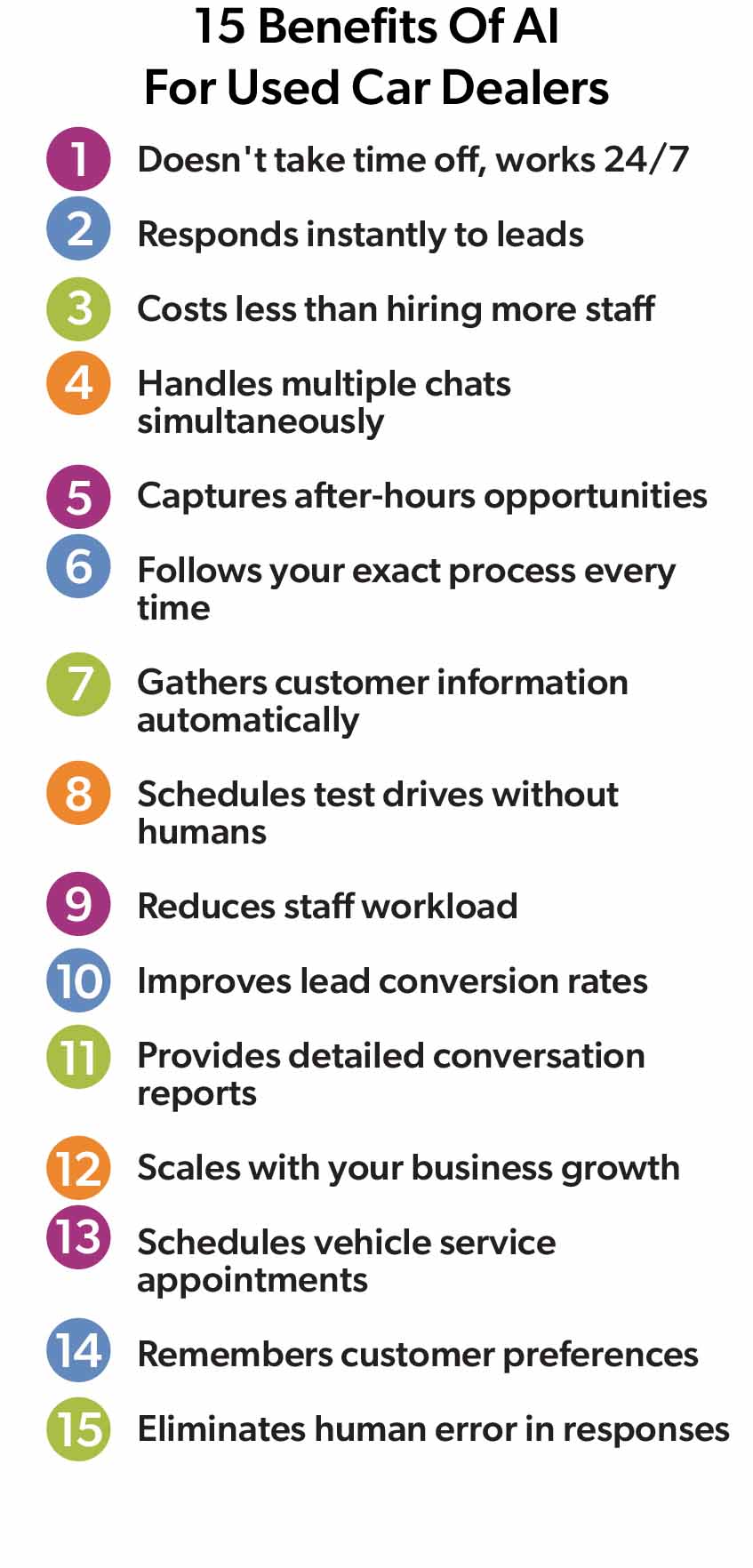 Independent dealers run on small, hardworking teams. The owner often acts as the general manager, sales manager, and head of finance all at once. AI gives these lean teams an advantage by automating the repetitive work of initial lead response.
This automation frees up your people to focus on what they do best: building relationships, closing deals, and sourcing inventory. Instead of being tied to a keyboard waiting for the next website lead, your team can spend more time on high-value activities that grow the business. AI handles the opening, so your staff can focus on the closing. This efficiency mirrors what we see with successful dealers in other areas - they find ways to maximize their team's impact without adding overhead. It helps you do more with less.
5. How Does AI Build Customer Consistency At Car Dealerships?
Your reputation is built on the quality of your customer interactions, your reliability, and trustworthiness. While AI doesn’t replace employees, humans have good days and bad days. A newer employee might not know the right answers, and even a seasoned employee can get overwhelmed during a rush, which can lead to inconsistent customer experiences. Bad reviews can turn off prospective customers. In our experience, dealers who maintain consistent quality standards tend to build stronger customer loyalty and referral networks.
On the other hand, AI is always consistent. After you and your implementation team program it with your preferred talk tracks, policies, and answers to common questions, over time it delivers that same professional response.
“If that AI agent gets the same question from three different customers, it's going to give them a consistent answer every time, which is not always the case when we're talking about people," Tinkham said. This control ensures every single lead gets the A+ treatment you want for your dealership.
Beyond consistency, AI can also gather and preserve customer information throughout the conversation.
"We're doing as much discovery as we can about that customer before we set the test drive," Tinkham said. "We're packaging up all that context in a very simple way for the dealer to know who's walking in the door, what they're interested in, and any details we've picked up along the way that make it feel like a really natural handoff. When that customer walks in the door, they don't have to start that process over again of ‘Here's who I am, here's what I'm looking for, here's the budget.’"
6. How Does AI Implementation Work At Car Dealerships?
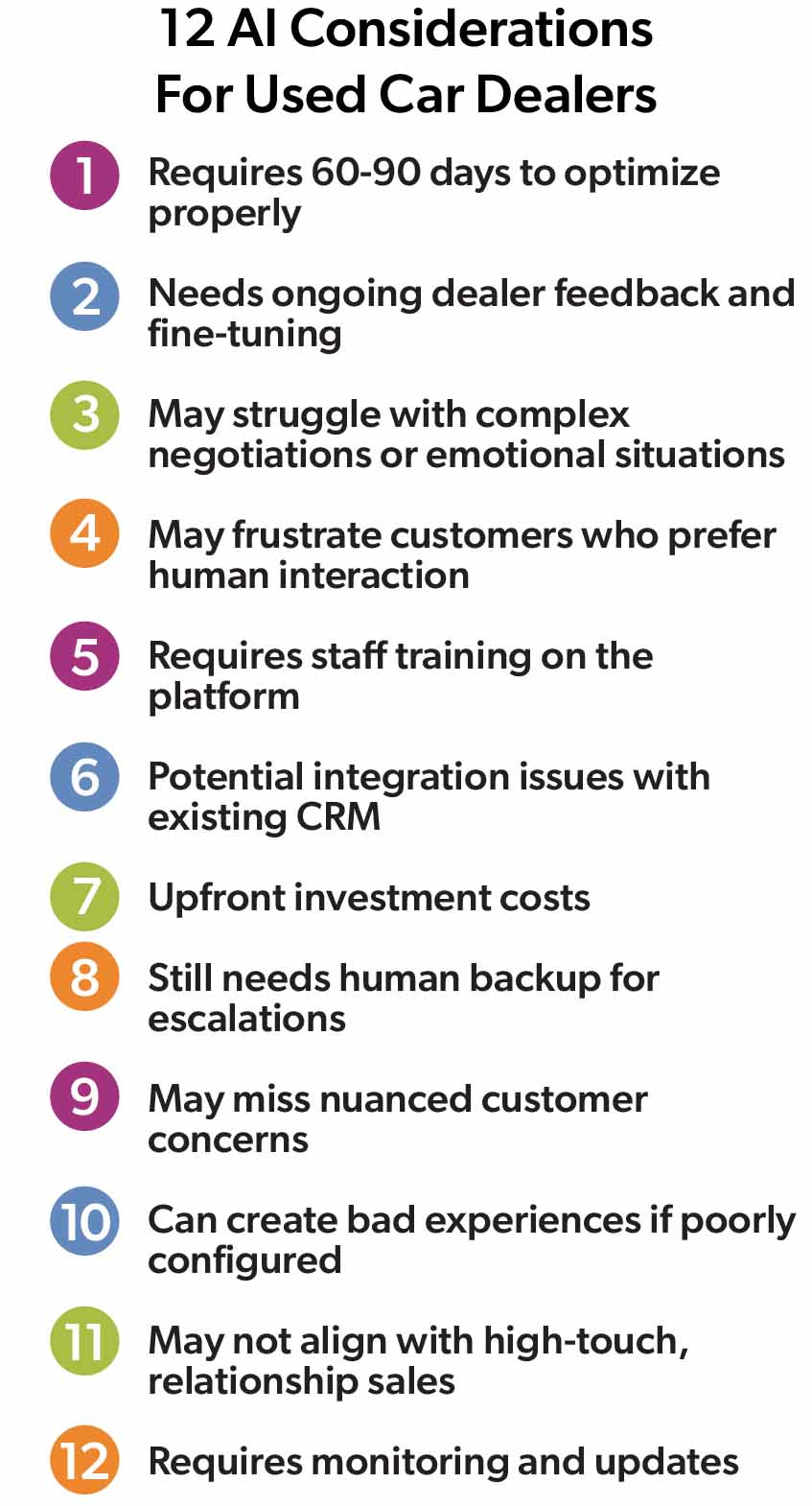 Tinkham said getting AI to work effectively at used car dealerships requires a period of setup and fine-tuning to match your dealership's unique operations. A reputable, experienced AI solutions provider will work with you to make it happen. He said you should expect at least a 60 to 90-day process to get the system fully optimized.
The most successful AI launches are collaborations between the AI vendor and the car dealership. "We look for dealers who want to partner with us," Tinkham said. "On our end, we need to have feedback from the dealer on what is going well and what they don't like. If we don't have that, it can be very challenging to get the AI platform operation to their specifications."
7. What Questions Should Used Car Dealers Ask AI Vendors Before Buying?
Chances are you might already be getting solicitations from one of the many companies making big promises about AI solutions. We’ve heard this from our dealer clients. Not all of these companies are experienced with used car dealerships or have a track record of success. To find the best AI platform for your used car dealerships, you need to get into the details before you sign anything. Learn the details about the AI solutions and ask questions like:
- What large language model (LLM) does the AI system run on?
- How many automotive dealers are currently using your platform and for how long?
- What specific data passes back and forth between your AI and our CRM system?
- Can you provide references from car dealers about the same size as ours?
- What's your technology roadmap for the next 6-12 months?
- How do you handle it when the AI system needs human intervention?
- What does your onboarding and training process look like?
- What ongoing support do you provide after implementation?
- How do you measure and report on conversion rates and performance?
"Take your time, talk to multiple providers, get reference checks and just have a list of questions of what's really important to you and your dealership and make sure you've got really sound answers to those questions," Tinkham said. Ask to speak with their current customers. Validate that it works with your customer relationship management (CRM) system. A few extra questions upfront can save you months of frustration.
8. How AI Increases Service Department Revenue For Car Dealers
Used car dealers might think of AI as a sales tool, but the technology can help your service department, as well. Our Floorplan Financing team often heard that independent dealers struggle with missed service calls throughout the day, representing lost revenue opportunities that can add up.
"We're seeing a lot of appetite to help optimize that end of the business," Tinkham said. "If you just think of the amount of missed phone calls that happen during the day for both sales and service, there's a large appetite in the market to leverage AI to turn those missed calls into revenue."
AI can handle routine service scheduling around the clock. When customers call after hours or during busy periods when your service team is occupied, the AI agent can check availability, book appointments, and collect necessary vehicle information. AI ensures service opportunities don’t slip through the cracks, boosting service appointment revenue without adding staffing costs.
9. How Is Voice AI Changing Phone Calls At Car Dealerships?
If you’re running a car dealership that tried a website chatbot a few years ago and you were unimpressed, Tinkham said you’re not alone. Since then, with the help of AI, the technology has made a big leap forward. The experience has gone from feeling "bot-like to human-like," said Tinkham.
Dealers are using voice AI to answer missed calls, book test drives, and schedule service appointments around the clock. Industry surveys show AI voice agents are now the top AI investment priority for dealers, ahead of every other use case.
While the tendency of independent used car dealerships is to wait on technology, waiting on AI now means you're losing sales to competitors using AI right now means competing against dealers who already have a head start. The performance gap between dealers who’ve adopted AI and those who haven’t is widening. Getting started today puts you in a stronger position to take advantage of what’s coming next and outperform in your market.
Updated: 7/30/2026