


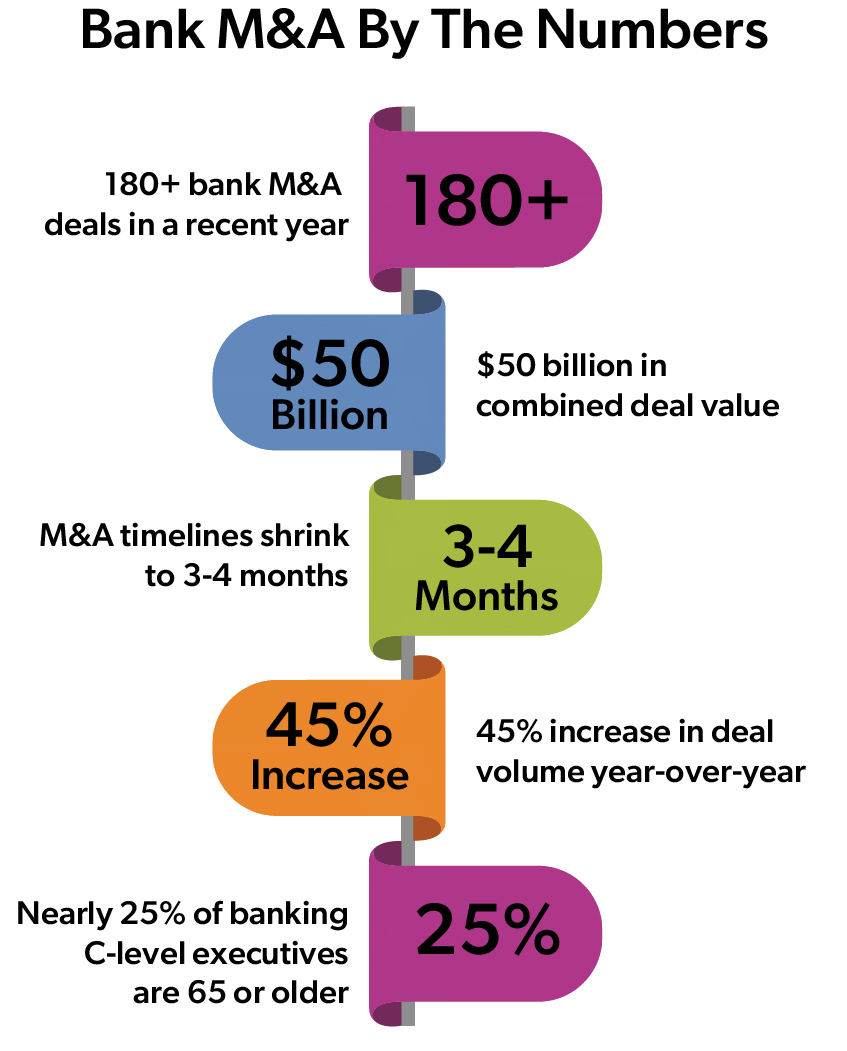
The pace of bank mergers and acquisitions has accelerated in recent years, with regulatory review lightening and shortening timelines that once ran nine months or more down to three or four months. In a recent year, more than 180 U.S. bank merger and acquisition deals were announced for a combined value of nearly $50 billion, according to S&P Global Market Intelligence.
 Most initial communications about bank mergers and acquisitions are reassuring, promising that transitions will be smooth, service will be seamless, and all clients are valued. For business owners, the impact goes far beyond whether checks clear and debit cards still work. When your bank gets acquired, you did not choose the new institution. The relationship built over years, the credit terms negotiated, the trusted client service standards that felt like a given: none of that transfers automatically. What follows is a clear-eyed look at what changes when banks merge, what to watch for as the transition unfolds, and how to decide whether the acquiring bank deserves your business or whether it is time to find one that does.
At First Business Bank, we have watched this play out across decades of working with business clients who have been on the receiving end of bank acquisitions, learning firsthand what business owners need to watch for when a bank gets acquired.
What's The Difference Between A Bank Merger And A Bank Acquisition?
The terms merger and acquisition are often used interchangeably, but the distinction matters for business banking clients. In a true merger of equals, the combined institution tends to draw from both banks — blending policies, people, credit philosophy, and culture. Business clients may retain familiar faces and recognize elements of the banking relationship they had before.
A bank acquisition works differently. When one bank purchases another, the acquired bank's clients are far more likely to end up looking like clients of the acquiring institution. Its systems, underwriting standards, fee structures, and culture take precedence. The bank a business owner chose and built a relationship with essentially ceases to exist, replaced by one they had no hand in selecting.
In practice, the line between the two can blur. Even mergers marketed as partnerships between equals tend to have a dominant culture emerge over time. Regardless of how the deal is structured, business owners should expect meaningful change and plan accordingly.
How Long Does A Bank Merger Take?
Historically, the period between a bank merger announcement and close ran nine months to over a year, giving business clients time to ask questions, evaluate the acquiring bank, and prepare for changes. Lighter regulatory oversight in recent years has compressed that window, with many deals now closing in three to four months.
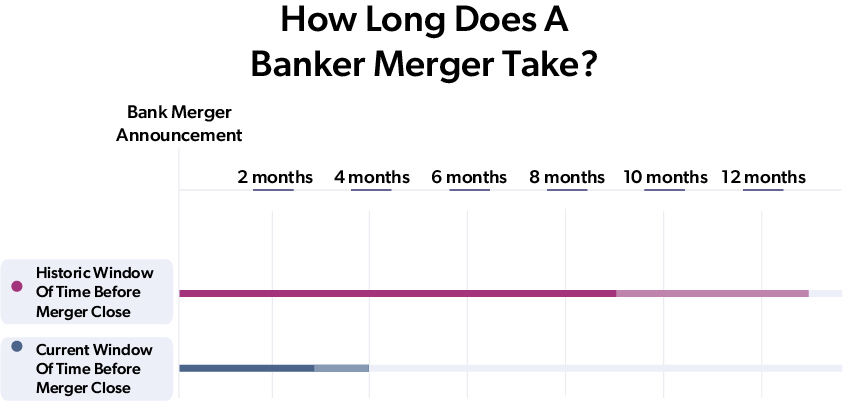
That shift has real consequences for business owners. Less time between announcement and close means less runway to audit loan renewals, assess treasury management continuity, and make an informed decision about whether to stay or start evaluating alternatives. Bank mergers and acquisitions are no longer a slow-moving process that business owners can monitor from a distance. When the announcement comes, the clock is already running.
What A Bank Merger Means for Business Clients
Business leaders can expect to see changes from a bank merger or acquisition arrive in waves. Some are immediate and operational, while others surface later, when a business owner realizes the new bank has a different approach. Here are some changes to watch for:
Lending relationships and credit appetite. The acquiring bank brings its own risk tolerance, and it may differ from the one a business owner has relied on. Renewal conversations can feel unfamiliar, terms that were standard may be questioned, and the relationship manager who knew the business may not be there anymore. Post-merger employee turnover spikes in the first year or two, and for the same reason clients feel displaced: the banker didn't choose the new employer any more than the client chose the new bank.
Industry and risk appetite mismatch. Some acquiring banks have less appetite for certain industries. Lending support can tighten over time without any explanation tied to the real cause. Underwriting standards shift. The financial ratios a new bank prioritizes may be entirely different from what a business owner was accustomed to. This is one of the more consequential changes clients don't see coming.
Treasury and cash management platforms. The core products, including fraud protection tools, are fairly similar across most banks since they run on comparable underlying systems. How they are delivered is the real difference. A large, dedicated team of treasury experts serving a regional market is a different experience than one regional contact covering a wide territory from another city.
Account numbers, routing numbers, ACH instructions, cards, and auto-pay. These changes land first on accounting and support staff, and the administrative lift is somewhat the same as changing banks.
Fee structures and product lines. Fees for services the business relied on can change, and some products may be discontinued or restructured. Read every notice carefully before assuming the relationship will look the same.
FDIC insurance coverage. If a business banks at both institutions involved in the merger, deposit balances at the two banks are insured separately for six months following the close. After that period, combined deposits are subject to the standard $250,000 per depositor, per institution limit. Businesses with significant deposits at both institutions should review coverage before the grace period expires.
How A Bank Merger Affects Your Existing Loans And Credit Agreements
On the surface, the news here is better than many business owners expect. By legal requirement, the following transfer to the acquiring bank at the original terms, even if the new bank’s policies are different:
- existing fixed-rate loans
- certificates of deposit
- signed credit agreements
However, these banking solutions are subject to change post-transition:
- variable-rate products
- lines of credit approaching renewal
- new credit requests
So you are forced to consider: Will a revolving line renew for the same term it always has? Will the new institution charge renewal fees the previous bank never did? Will it place the same weight on the financial ratios and collateral structures the business has built its credit profile around? Those answers are not guaranteed, and they do not become clear until a renewal conversation is already underway.
That’s why timing matters. Business owners who identify upcoming loan renewals and credit facility expirations early, before the transition closes, have options. Those who surface those conversations after the fact, when a renewal is already in front of a new credit team with different priorities, have fewer. Getting ahead of the calendar is one of the most practical moves a business owner can make in the window between bank merger or acquisition announcement and close.
Should You Switch Banks After a Merger?
Only a business leader can answer this question, and the answer depends less on how smooth the transition goes and how well the acquiring bank can deliver. A banking relationship built on specialized expertise and direct access to decision-makers does not automatically transfer when one institution buys another. It is better to verify rather than assume.
Here are questions to ask before deciding to stay or start evaluating new banks.
Who will be my relationship manager, and do they have decision-making authority? A new name and a new face are one thing. A contact who has to escalate every meaningful request to someone you have never met is another. Find out early.
If I bring a $10 million request to this bank, who is in the approval chain, and can I meet them? Access to decision-makers is one of the first things that changes after a bank acquisition. The larger the acquiring institution, the further removed those decision-makers tend to be. Knowing who they are before you need them matters.
Does this bank have experience in my industry? Industry knowledge is not transferable. If the relationship at the previous bank was built on a banker who understood your business model, your seasonality, or your collateral, that expertise needs to exist at the new institution.
Will my credit facility be reviewed, and on what timeline? Get this in writing if possible. Understanding when a review is coming gives business owners time to prepare, not just react.
How will my treasury services be handled during the transition? ACH setups, online banking access, positive pay, and other cash management tools all carry operational risk during a changeover. Ask specifically, not generally.
What products or services may change or go away? Banks rationalize product lines after acquisitions. Something a business has relied on may not survive the integration. It’s better to know now than to discover it at a moment of need.
Steps to Take When Your Bank Is Acquired
The announcement of a bank merger is a moment to take action. The window between the banks’ announcement and close is narrower than it has ever been, which means the clock is ticking on your opportunity to ask questions and prepare.
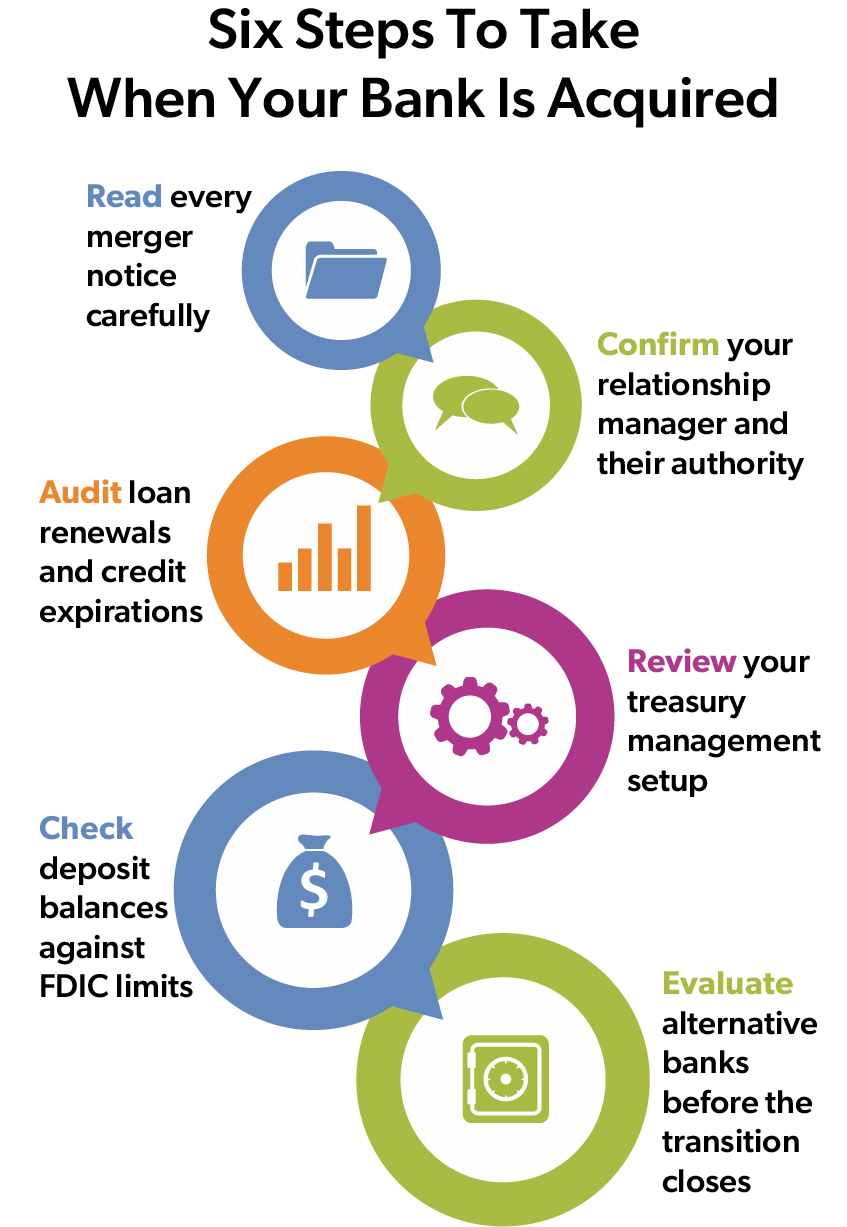 Read every notice carefully. The fine print in bank merger communications often contains meaningful details about fee changes, account structure, and product availability. Do not set notices aside assuming the summary covers everything.
 - Identify your relationship manager and confirm continuity. Find out who your primary contact will be at the acquiring institution and whether that person has genuine decision-making authority or will need to escalate routine requests.
- Audit upcoming loan renewals and credit facility expirations. Timing matters here. Renewals coming due during or shortly after a transition will be evaluated under the acquiring bank's standards, which may be different. Know what is on the calendar before the transition closes.
- Review your treasury management setup. Flag anything that could be disrupted, including ACH instructions, online banking access, positive pay configurations, and automatic payments.
- Check deposit balances against FDIC limits. If you bank at both institutions, your deposits are insured separately for six months following the close. Use that window to make any necessary adjustments.
- Start evaluating alternatives. Even if you plan to stay, running a parallel evaluation is not disloyalty to the new institution. You did not choose this bank. Making an informed decision about whether to remain with it is entirely reasonable.
When Your Bank Is Acquired, Do You Know Who to Call?
After years with the same bank, most business owners know exactly who to call when something goes wrong. A bank merger or acquisition resets that reliability.
Banking issues rarely announce themselves in advance, and they range from the mundane to the urgent. A password reset that locks out payroll access. An employee who responded to a fraud scheme and sent a wire transfer. In either case, it matters whether someone at your new bank picks up, takes ownership, and resolves it the same day.
The questions to ask the acquiring institution before that moment arrives: Does a live person answer the phone? If they are unavailable, does someone call back the same day? Does the bank have a track record of resolving both routine and high-stakes issues quickly? Do they follow up after the fact to confirm the resolution was clear? Efficient problem resolution is the number-one reason business clients cite for why they value a banking relationship, or why they left their last one. It is not a sophisticated metric, but it is the most honest one. When something goes wrong, everything else about the relationship is tested.
A bank merger puts business owners in an unfamiliar position, managing a banking transition they did not initiate with an institution they did not select. The good news is that the same scrutiny that should follow any major business decision applies here. Ask the hard questions early, assess the answers honestly, and make the choice that is right for the business.
For business owners who decide it is time to find a new banking partner, First Business Bank has spent more than three decades growing through relationships, not acquisitions. We have made one acquisition in our history (2014), and adding to that is not part of our strategy. When you choose First Business Bank, you are choosing a bank that intends to be your bank.
What Makes a Banking Partner Worth Keeping?
A banking relationship is easy to take for granted when it is working. Transactions process, lines of credit renew, treasury tools run in the background, and the day-to-day feels unremarkable. That is what good banking looks like. The relationship only becomes visible like during a merger, a cash-flow crisis, a fraud event that needs same-day resolution.
Those moments reveal whether a bank is a vendor or a partner. A vendor processes requests. A partner understands the business well enough to anticipate what is coming, picks up the phone when something goes wrong, and brings real decision-makers to the table when the stakes are high. Industry knowledge, direct access, proactive communication, and follow-through after the deal closes are not differentiators in banking — they are the baseline of what a strong relationship should deliver.
A bank merger or acquisition is a reasonable moment to ask whether the institution inheriting your relationship meets that standard. The acquiring bank may be excellent. The point is to find out rather than discovering the answer when you need them most.
Frequently Asked Questions About Bank Mergers & Acquisitions For Business Owners
What happens to my business accounts when my bank is acquired?
Account and routing numbers typically change, which means ACH instructions, auto-pay setups, and direct deposits all need to be updated. The administrative work lands first on accounting and support staff and is, in practical terms, the same process as switching banks. FDIC coverage also warrants a second look: if your business banks at both institutions, deposits are insured separately for six months following the close of the merger, after which the standard per-institution limits apply.
Will my loan terms change if my bank is acquired?
Existing fixed-rate loans, certificates of deposit, and signed credit agreements transfer to the acquiring institution at their original terms — that is a legal requirement. What is not protected is everything that comes up for renewal or is requested fresh. Lines of credit approaching renewal, new credit requests, and variable-rate products are all subject to the acquiring bank's underwriting standards, which may differ meaningfully from what your business has been accustomed to.
Should I switch banks after a merger?
That depends on what the acquiring institution can actually deliver, and the only way to find out is to ask directly. Relationship manager continuity, familiarity with your industry, access to real decision-makers, and a clear answer on how service issues get resolved are the right places to start. A smooth transition and a strong long-term banking relationship are two different things.
Update date: 10/13/2026